If two opposite vertices of a square are (5, 4) and (1, -6) then the coordinates of its remaining two vertices are
হানি নাটস
Solution−ABCDisasquare.SoAB=BC=CD=DA&thediagonalsAC=BD..........(i).Weshallapplydistanceformulatogettheabovelengths.d=(x1−x2)2+(y1−y2)2.NowΔABCisarightonewithACashypotenuse(∠ABC=90o).∴AC=(5−1)2+(4+6)2units=116units=BD(byi)........(ii).Weknowthatsideofasquare=2diagonal.∴AB=BC=CD=DA=2116units=58units.........(iii).Now,usingthedistanceformulad=(x1−x2)2+(y1−y2)2,AB2=BC2⟹(x1−5)2+(y1−4)2=(x1−1)2+(y1+6)2⟹8x1+20y1−4=0⟹2x1+5y1−1=0⟹y=51−2x1........(iv).∴AB2+BC2=AC2⟹(x1−5)2+(y1−4)2+58=116(fromii&iii)⟹(x1−5)2+(y1−4)2=58⟹(x1−5)2+(51−2x1−4)2=58⟹29x12−174x1−464=0⟹x12−6x1−16=0⟹(x1−8)(x1+2)=0⟹x1=(8,−2).So,from(iv),y1=(51−2×8,51−2(−2))=(−3,1).∴B(x1,y1)=(8,−3)and(−2,1).SimilarlyAD2=DC2⟹(x2−5)2+(y2−4)2=(x2−1)2+(y2+6)2⟹8x2+20y2−4=0⟹2x2+5y2−1=0⟹y2=51−2x2........(iv).∴AD2+DC2=AC2⟹(x2−5)2+(y2−4)2+58=116(fromii&iii)⟹(x2−5)2+(y2−4)2=58⟹(x2−5)2+(51−2x2−4)2=58⟹29x22−174x2−464=0⟹x22−6x2−16=0⟹(x2−8)(x2+2)=0⟹x2=(8,−2).So,from(iv),y2=(51−2×8,51−2(−2))=(−3,1).∴D(x2,y2)=(8,−3)and(−2,1).Sothecoordinatesofothertwoverticesare(8,−3)and(−2,1).ans−OptionB.


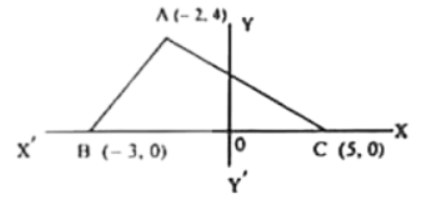 BC এর মধ্যবিন্দু কত?
